Pietra's trauma and violent fixation
Hold TightPietra's trauma and violent fixation begin with the destruction of her family during ethnic cleansing in what used to be Yugoslavia. She survives the deaths of her husband and son, is rescued by Nash, and later turns revenge into an enduring purpose. Her past does not remain separate from the present: it shapes both her capacity for violence and her judgment that uncertainty can be made into a form of suffering.
Identity and Background
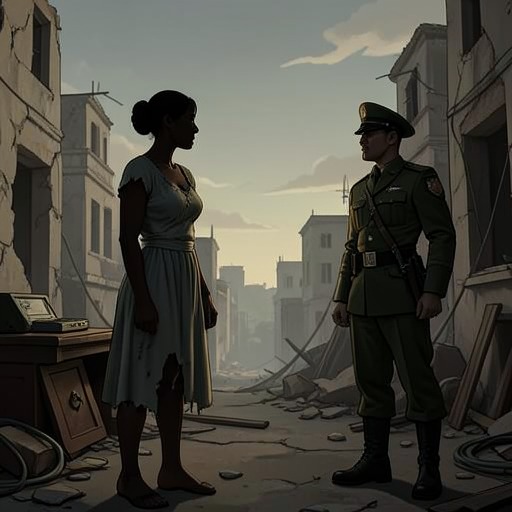
Years earlier, Pietra was a young actress in Yugoslavia. During ethnic cleansing, Serbian soldiers killed her husband and son in front of her, while she too endured their violence. Nash, then working as a military mercenary, rescued her. The account describes her as having survived when her family did not, a survival that brings no simple return to ordinary life.
After the rescue, Pietra is portrayed as emotionally emptied out. She seems to come alive when she must act, as when she and Nash seize Marianne in a bar; otherwise, she appears detached. This contrast gives her outward stillness a specific history. The violence of the past is not presented as an episode she has put behind her, but as the event around which her later conduct and sense of self have formed.
From Survival to Revenge
Pietra's desire for vengeance takes shape during her recuperation. Three weeks after she leaves the hospital, she and Nash find one of the soldiers who tortured her family. Nash binds and gags the man, gives Pietra pruning shears, and leaves her alone with him. The soldier takes three days to die; by the end of the first day, he is pleading for death, but Pietra does not kill him then.
The decisive fact about this retaliation is not only its duration, but Pietra's response to it. The experience does not leave her feeling that revenge has been exhausted or that justice has restored what was taken. She relishes the act and becomes more hungry for vengeance. The story therefore makes revenge less a resolution than a reinforcement: the punishment gives her appetite a direction without bringing her family back or undoing what she witnessed.
The Present: Reba and the Power of Not Knowing
In the present, Pietra's fixation informs Nash's decision to keep Reba hidden. Nash has left Marianne's body where it can be found, but intends for Reba to disappear. He leaves Reba's car in a hotel parking lot, anticipating that investigators may interpret it as evidence of an illicit meeting and pursue the possibility of a boyfriend. Without a body, he reasons, the police may have little to follow and could conclude that she ran away. The concealment is designed to sever the connection between Reba and Marianne and to prolong the uncertainty for those looking for Reba.
Pietra identifies that uncertainty as the distinctive cruelty of this plan. In her view, causing physical pain is familiar to them; making someone spend the rest of his life wondering what happened to the woman he loved is worse. Her judgment connects the present scheme to her own experience of watching her family suffer and die, but the evidence does not suggest that this identification makes her question the harm she is helping to inflict. Instead, she recognizes the difference between bodily suffering and the lasting torment of not knowing.
Nash, Cassandra, and the Unresolved Fixation
Nash tells Pietra that he promised Cassandra, and asks whether she understands. Pietra does not answer immediately. When she speaks about what happened to her family, she emphasizes that her husband and son witnessed her suffering as well as enduring their own. The exchange places her memory beside Nash's appeal to a promise, without making the two experiences equivalent: her account gives the present violence a personal history, while Nash uses his commitment to Cassandra to explain why he must continue.
Pietra asks whether the uncertainty imposed on Reba's loved one might someday end. Nash agrees that when they have finished, they will reveal the truth. That promise establishes a limit in their stated plan, but not a change in Pietra's relationship to violence. She accepts that the truth will be disclosed later; in the meantime, she participates in keeping Reba's fate unknown. Her trajectory thus remains unresolved: rescue did not release her from the past, revenge deepened her appetite, and the present offers her another occasion to turn remembered suffering into deliberate uncertainty.